<link rel="me" href="https://www.blogger.com/profile/10875910395291494520" /> <meta name='google-adsense-platform-account' content='ca-host-pub-1556223355139109'/> <meta name='google-adsense-platform-domain' content='blogspot.com'/> <!-- --><style type="text/css">@import url(https://www.blogger.com/static/v1/v-css/navbar/3334278262-classic.css); div.b-mobile {display:none;} </style> </head> <body><script type="text/javascript"> function setAttributeOnload(object, attribute, val) { if(window.addEventListener) { window.addEventListener('load', function(){ object[attribute] = val; }, false); } else { window.attachEvent('onload', function(){ object[attribute] = val; }); } } </script> <div id="navbar-iframe-container"></div> <script type="text/javascript" src="https://apis.google.com/js/platform.js"></script> <script type="text/javascript"> gapi.load("gapi.iframes:gapi.iframes.style.bubble", function() { if (gapi.iframes && gapi.iframes.getContext) { gapi.iframes.getContext().openChild({ url: 'https://www.blogger.com/navbar/12582298?origin\x3dhttp://johnbai3030.blogspot.com', where: document.getElementById("navbar-iframe-container"), id: "navbar-iframe" }); } }); </script>

Thursday, October 27, 2011

Money Driven

Apparently it's National Blog Post Writing Month. Seems pretty easy. And I, unlike the many lazy bloggers cluttering up the internet, will be finished well before November 30th. So here you go... Streimikes inspired by NBPWM. Perhaps you can look forward to another blog post next November!

---

A few weeks ago I listened to an NPR story about kids from a Lakota reservation being taken by South Dakota state child welfare workers and placed in foster care. This was a common practice in the old days. Native kids would be restricted from practicing their religion, have their heads shaved, and were generally forced to assimilate. But things changed. The Indian Child Welfare Act was passed and there are federal regulations now about taking children from tribes. But this NPR reporter had dug up some profoundly disturbing things about what was happening in the Lakota Nation. In South Dakota, children were still being regularly taken away from the reservation. They weren't being placed with relatives or other Indian families. And there seemed to be very little communication or cooperation with the local tribal authorities about what was happening.

The journalist found out that the State of Dakota was getting millions of dollars every year from the federal government to help subsidize these placements. Federal matching funds are used to help pay for the very expensive foster care system. And every native kid was classified as "special needs" simply due to their race. That meant additional revenues for the state. The reporter also found former officials willing to testify that there was corruption. These officials went on record to say that South Dakota is a very poor state... and that the millions of dollars that were streaming in to pay for these programs meant valuable jobs for an industry-poor region.

The story went on to talk about one family's fight to get their children back, and about a plucky lawyer willing to fight the state government's unwritten policies. But mostly, it was just a sad story about what happens when money trumps humanity.

---

Naturally, this made me think of dentists. I have been amazed by the pressure all dentists seem to exert regarding night guards. It's not that I think night guards are a bad idea. It just seems preposterous to pay $500 for one. People have argued that they have to cost this much because they are molded perfectly to your mouth. But the $5 athletic mouth guards that I wear playing softball are also form-fitted. I heat up the new mouth guard over steam until it's pliable, then put it into my mouth and bite down on the softened plastic. It cools and hardens in the exact shape my mouth requires. This amazing technology costs peanuts... and yet dentists push the $500 night guards on everyone. I have never heard a dentist suggest the $5 version to a low-income client... and I've overheard a lot of conversations between my dentists and the other patients sitting ten feet to my left or right.

Recently I got my first crown. I decided that I trusted the dentist's word. He said that I needed it to avoid a future root canal. But it really bothered me that between my insurance and me, I paid over $1200 for a procedure that took the dentist about an hour. To be fair, it also seemed to require about 50 cents worth of porcelain. Given the profitability of this procedure, what would stop dentists from prescribing crowns to almost every person that walked in... regardless of how necessary or helpful they would be? Why should I believe that money isn't trumping humanity here as well?

---

This line of thinking made me want to call that NPR reporter... But not because I want him to investigate dentists and the corrupt night guard and crown manufacturing industries. I've decided that everyone knows dentists are evil. That would just be beating a dead horse.

The story I want cracked involves the strange rates of emergency c-sections being performed on immigrant and refugee women. C-sections are a legitimate procedure when natural child birth is not an option. And there can be all sorts of reasons for this... but being an immigrant is not one of them. In my job I see a great many women (women who have already successfully given birth many times!) ordered to get c-sections. There is usually no justification given to these clients... just a doctor's recommendation.

A quick bit of research found this study from the State of New Hampshire. Here's a money quote: "The rate of c-sections nationally has increased 53 percent between 1996 and 2007, to an average rate of 32 percent. There is no consensus about the short and long term benefits and risks to the mother and infant, and even though c-sections are performed routinely, many patients do not realize that the procedure involves major abdominal surgery and is associated with surgical complications and maternal readmissions. C-section provider charges and payments are often substantially higher than for vaginal deliveries, increasing medical care costs to the patient, the insurer, and they health care system in general."

Has the birthing process also succumbed to the same level of greed that child welfare and dentistry have?! And should I fight this? Should I be fighting this trend in my work as a social worker and advocate for vulnerable refugee women in south Seattle?

Labels: ,

Wednesday, March 03, 2010

Talking 'Bout a Revolution

Those of us who talk about our dreams
suffer a sad tendency not to fulfill them.
There is something about voicing the ambition
that robs it of its potency.

Those who keep closed council
and chart their course with only the stars as guideposts...
they are never tired; action is their lifeblood.
But I know little of them for they do not speak.

Once loosed from the lips, I lunge and clutch at my words
trying vainly to re-ingest them.
One day I'll brim with motivation and it won't matter,
or else I'll join that brotherhood of the comfortable silence.

Labels: ,

Wednesday, February 17, 2010

Feeling Defensive

Some recent clinical work at my day job has me thinking about defensiveness. Specifically, I've been considering the defenses of the ego, the cataloging of which began with the early Freudians... and the interpretation and categorizing of which continues today. Pop culture includes a fairly intuitive definition of defense mechanisms: self-protective thoughts, attitudes and behaviors that people exhibit when they are threatened by internal or external stimuli. Most people have heard of some of these and have an idea how they work. Some examples you've probably run across include projection, denial, and passive-aggression. Here's an illustrated example of another common defense: when Mary's boss tries to confront her about a chronic tardiness problem, Mary starts to indulge a vivid daydream about a guillotine decapitating that boss. The image allows Mary to avoid the brunt of the criticism, preoccupying her conscious mind with playful mayhem instead. After the supervision meeting is over, Mary has successfully avoided being challenged by her boss's feedback. Her ego (or self image) has been protected by virtue of the defense mechanism.

According to George Vaillant's classification of ego defenses, Mary is exhibiting the "fantasy" defense. It's classified in his second tier of defenses labeled "Immature". His other tiers are "Pathological", "Neurotic" and "Mature". Immature defenses like fantasy escape are considered developmentally typical of children. If Mary was a 4th grader, this behavior would be normal and expected. But if she's a 28 year old professional file clerk... this behavior signals an unhealthy defense tactic. It's unhealthy because it succeeded in protecting Mary, but at too high a cost. The cost was that she was unable to actually engage with the criticism or consider a change to her long-term behavior.

So, since most of us strive to improve our mental health, what are the healthy defenses? Vaillant's list of the "Mature" defenses includes:

Altruism - Achieving satisfaction by doing for others.
Anticipation - Wisely planning for future distress with self-care.
Humor - Laughing while confronting the absurdity and frustrating truths of life.
Identification and Introjection - Allying your self-image with that of another person or object.
Sublimation - Transforming negative thoughts/feelings into some positive activity or expression.
Thought Suppression - Consciously pushing a difficult thought "back down" so that it can be dealt with later.

How might Mary utilize these defenses instead of her violent escape fantasy? She might accept the tardiness criticism as valid but balance the blow to her ego with bolstering thoughts that she's a good person and will continue to do good works for others. She might have anticipated and prepared for the meeting with her boss, bracing herself for the impact of the criticism. She might try to find aspects of her shortcomings that she can laugh at, accepting the feedback as something she struggles with even if it seems ridiculous. She might soften the criticism by identifying with a respected coworker who is also often late, but admirable in other ways. She might deal with the feelings of shame at being called out by her boss by creating art, exercising, or putting extra energy into preparing a lavish dinner party for friends later that night. And instead of melting down in her boss's office, she might decide to suppress her emotional reactions until she's alone in her own office and it feels like a safe place to cry or vent.

These are all preferable, or more "mature" reactions, from a mental health therapist perspective... though they aren't terribly fun to talk about or laugh at. If I'm to look at myself, I think I have issues with a couple of Neurotic-tier defense mechanisms: Intellectualization and Rationalization. I think much of my own self-work involves trying to get over these old habits and to embrace some healthier options.

Labels:

Tuesday, December 22, 2009

The Yin and Yang of Affect

This article from the BBC got me thinking about an old conversation with Science Officer Alex Tokar. A few years ago Alex related an unintuitive theory to me. He explained that certain mental illnesses serve an evolutionary purpose for the species. The premise is that certain fragilities set us up to be metaphorical canaries in the coal mine. If some people are more prone to depression, perhaps they'll be the first to see that we should give up and run away from an unwinnable war. Or perhaps the more anxious among us will be the first to notice that an economy that doesn't produce anything is unstable by definition. And the most paranoid among us may be the first to notice that the government has repealed many civil liberties that we had taken for granted. All of these observations can be helpful to our society, and evolution may smile upon these traits. Those who think so far outside the norm as to be labeled "mentally ill" can serve an important function (if we listen to them) to those of us who tend to think inside the lines and may be blinded to dangerous realities.

(Please note: I am not so naive as to romanticize the disabling effects of mental illnesses. But this is a strengths-based model... so we're focusing on the upside here, not the hardship.)

The article I linked to doesn't actually mention mental illness, but it points out that "grumpiness" as opposed to "cheerfulness" actually has serious advantages. Researchers have demonstrated that people in a grumpy state of affect are able to process information more quickly and more accurately. They are also better observers and reporters than cheerful folk. However, this is not a one-sided finding. Happiness seems to promote creativity, flexible thinking and cooperation.

It would appear to me that we need a combination of both to thrive... that they fit together like white and black fields in the yin and yang symbol. Together, they dovetail and create a powerful whole. While each individual may be stuck being "happy" or "grumpy", each group of people ought to aspire to incorporate (and maximize) the skills associated with each side. It would be silly to label either side more important than the other.

An old colleague of mine, a moderately functional IT specialist named Ward, used to tell me that every good company should hire at least one crackpot... one guy that's really different. And that nutjob would provide a tremendous benefit to that company by thinking differently, predicting problems that no one else could foresee and making suggestions that no one else was likely to imagine. Ward, of course, was our company crackpot... so it stands to reason that he would have such an elegant theory at hand for his defense. Anyway, his theory holds water according to this model.

Most of what I'm saying seems like common sense and common knowledge. And yet, we still have a tendency to pathologize whichever end of the spectrum we don't inhabit. When it comes to the grumpy/cheerful continuum, those who sit in the soft blue glow of pessimistic rationality see our sanguine-hued brethren as muppet morons... While the red-cheeked optimists often look down with pity at the cranky Blue Meanies. One of the universe's laws is that of opposites attracting, and its utility seems obvious. We need to bond with other entities that complete us.

So why do we deride these potential partners? Why do we resent those who embody what we lack and need? Is it because they remind us of our inadequacies? Is it that we fear ceding power to the "other"? Certainly many of us resist allowing the "other" into our lives, preferring to find like-minded people to blend in with. It appears that "opposites attract" is directly countered by the universal truth that "birds of a feather flock together." What to do, what to do?

Labels:

Friday, October 16, 2009

Capitalism: An Open Letter to Michael Moore

Curse you Michael... for being an unapologetic cheat. You do this every time, and it kills me. You do a ton of quality investigative reporting and great interviews, you stage impressive public demonstrations... and then you make conclusions that are populist rhetoric crap with no substance. It just kills me.

Yes, by all means... let's get rid of capitalism (as you suggest) and "Replace it with democracy." What the heck does that even mean Mr. Moore? Are you saying we should get rid of banks, private property, the marketplace, Wall Street, and Amazon.com and replace it all with public forums where every citizen gets one vote? That makes no sense. How do you replace an economic system with a decision-making system?

I suppose you probably meant, "Let's tear down this plutocracy with massive rebellion and put the power back in the hands of the people." But that's not democracy... that's revolution. And if you're ballsy enough to state overtly that "Capitalism is evil"... it's hard to imagine you're afraid to openly say "Let's get the revolution started." But, most importantly, you dodged the question. Just what are we supposed to replace capitalism with? Democracy doesn't cut it. That might work for the angry masses... but when you rally people with false ideas, you're little better than the petty dictators that constantly rise and fall in unstable regions of the world... each one promising the people liberation, but delivering just another flavor of genocide, servitude and torture.

Maybe what you were trying to say is, "Let's replace capitalism with socialism!" That would have made sense. It would have been consistent with your stance that Canada and Europe have better health care models. It would have given you an honest platform to stand upon. You could have allowed for continuing the banking system, the investment process, the practice of small business ownership and a competitive marketplace. All these things can happily exist within socialism... there are just more protections and regulations. You definitely waxed nostalgic for the Roosevelt administration: when taxes on the richest class of people were significantly higher, protections for unions were significantly better, and the ruling class seemed to understand the value of wealth redistribution. Well, that was still capitalism. There was just a better class of people at the highest level of government.

Your chapters about the moral bankruptcy of our leaders was interesting. I never expected you to get two priests and a bishop to agree that capitalism was "evil". It wasn't until I read Mountains Beyond Mountains, a book about Dr. Paul Farmer's work in Haiti, that I even considered Catholicism as anything but a force of tyranny by bamboozlement. That book introduced me to the idea of "liberation theology"... that many of the priests and nuns in devastated parts of the world are staunch advocates of the poor in the face of hostile governments. The idea that the Catholic priesthoods of Chicago and Detroit have become the same thing (an ally to the poor in a forsaken land) is... compelling. I'm not sure I'm willing to completely buy this line... but I'm interested in hearing more if you need an idea for your next movie. And I hope to God that you weren't suggesting we replace capitalism with theocracy!

I still love you and your work Michael. I wish you'd quit cheating, but you're the only one putting this much humor and style into these kinds of documentaries and I've appreciated all of them. You may never produce another one quite as brilliant as Bowling for Columbine or Fahrenheit 911, but I'll still be giving you my dollars at the box office... it's the capitalist way.

By the way... I thought that this was the most effective 58 seconds of the whole film:


This snippet makes your central point about government being hijacked by the banking industry better than any of the anti-capitalist rhetoric.

Update:
I found this audio interview between Howard Stern and Michael Moore on Youtube. The clip should auto-load parts 2, 3, 4, etc. In the interview he discusses his motivations and relationship with capitalism in greater depth... and in an uncensored fashion. I found myself appreciating his work even more as I listened.

Labels: ,

Wednesday, August 12, 2009

Getting Consistent

Jeering and howling, the ugly faces of the indignant and the ignorant are ambushing congressmen and townhalls across the country. They cannot abide this socialist administration trying to force health care upon its people. They spread misinformation and shout down opposition. If you read the news, it sounds like they're trying to start a goddamn civil war.

At first, I came here to make a tired argument. It goes something like this: We do not need to fear government-run programs. Everyday we take all kinds of government run programs for granted. We count on the mailman and the fire department and the school teacher and the police department and the coast guard to keep society safe and running smoothly. Cue the 1950's music and old educational video montage. We count on government programs to provide social security and Medicare for our elderly, student loans to our youth, and to preserve green spaces for everyone. The government makes sure that streets are paved, homes have electricity, and that we're notified if a child molester moves in next door. These programs have all been run by the government for years, and they work. They work quite well. So you see America... there's no reason to fear socialized medicine... you've been enjoying a socialized fire department for years!

As I was rehearsing this argument, I was struck by a thought. Why the hell have we allowed so many critical aspects of our society to be run by corporations instead of the government?! The government exists to ensure the public interest... and they have been the only ones we can rely on to provide many fundamental services that were too important to leave to the marketplace.

Clearly there are many systems that private corporations would love to get their profiteering hands on. Corporations love running prisons (they not only get government money to handle the prisoners, they also get to use the inmates as slave labor in sweatshops... it's win-win!) Frankly, there's good reason to fear corporations running the programs that we rely on to keep society running smoothly. They may handle things more efficiently, but they also take greater risks and don't have a strong track record of planning for sustainability. Their motivations are not ultimately to serve the public interest. While I think corporate competition and innovation are great for fields like movie-making, restaurants, biochemistry and car manufacturing... There are certain services in our society that shouldn't be left to chance or influenced by corporate ethics.

What are they?

Well, there's education. I'm very happy that we have a public school option all the way through university studies. I'm not saying we shouldn't have corporate or religious alternatives; I'm just wedded to the idea that there should ALWAYS be a government option.

There are the police and armed services. I'm not always very happy with them, but I'm VERY thankful that they are operated by the government instead of private industry. Just look at Blackwater's record to see why.

There's... um... waste management. And environmental protection. We NEED clean air and water to survive. What else are requirements for survival? Obviously, there's food, clothing and shelter. And here's where I'm flabbergasted. For all these years we've allowed food, clothing and shelter to be run by corporations. America seems to nurture a fear about Soviet living... that we'd all be wearing burlap sacks, chowing on Soylent Green and living in miniature gray hexagonal pods if the government had its way. But that is nonsense. Except for maybe the hexagonal pods part. That could really happen. I suppose there has been a "government option" in these fields... the government has subsidized food and clothing banks, and there are a lot of subsidized housing projects. But these are government/private partnerships at best. I think we need a genuine, 100% government-controlled, non-profit option in these fields.

And I'd add energy to the list. Sure we have some state-run electrical grids... but I mean gasoline, oil, and natural gas. And high-speed internet, and cell coverage, and mass transit. These things are too important to be left to the whims of the marketplace. Maybe you can think of some other things that I'm missing?

So, I started out thinking that all this paranoia about a government option for health insurance was silly... but now I'm feeling more and more outraged. Why are we not demanding a public option for a variety of other services we all depend on? Let's get consistent on this!

Labels:

Tuesday, June 16, 2009

Humanity is NOT a Virus

We're actually much more like a cancer.

This happy realization came to me while listening to James Lovelock on NPR the other morning. He's a right chipper English bloke, member of the Royal Society of Fellows, and proponent of the Gaia Theory. This theory holds that the Earth is a living organism made up of subsystems... that various species of flora and fauna operate the way different organs work in a human body. They all work in concert to achieve a self-regulating stability. The human race can be compared to the central nervous system or "brain" of this earth-organism. As Lovelock points out, the earth can now actually defend itself from a potential asteroid collision thanks to the miraculous efforts of it's brain organ. Hurray for growing brains. Hurray for Gaia's evolution. Hurray for humanity.

However...

We're also growing at a completely unsustainable pace. We're savaging many of the other "organs" in order to feed our own advancement. As Al Gore and any other environmentalist will tell you: when we cut down rain forests to build cattle ranches or burn fossil fuels for energy, we're causing a breakdown in the delicate balance that sustains Gaia, and soon the planet will become a lot less inhabitable. But I no longer see us as a parasitic virus... feasting on the husk of a depleted planet. Instead, I see us like a cancerous tumor... multiplying in size despite the adverse consequences to our own species and to all of our neighboring species. The good news is that there is nothing inherently wrong with humanity... no more than there is something inherently wrong with evolving a brain. We just happen to represent a nasty case of cancer to our mother Gaia at the moment. I'm hoping we don't have to resort to radiation treatment.

Labels: ,

Thursday, May 21, 2009

In Case you're too Lame to watch Ill Doctrine

Here's an example of why I love J Smooth and Ill Doctrine so much. I don't give a crap about Asher Roth... In fact, I'd never heard of him before this video... but J has a way of connecting the dots for people around the tricky topic of race relations. I wish there was a way to give Ill Doctrine an internet hug.

Labels:

Monday, May 04, 2009

Performance Enhancement: Now It's Our Turn!

The New Yorker just ran an interesting article about the use of neuro-enhancing drugs. Drugs like Adderall, typically prescribed for people suffering from ADHD, create higher levels of concentration and focus for normal people. College students have flocked to them as they once did nicotine and caffeine. They're seen as survival aids in the more competitive schools, or for hyper-achieving students that want straight A's while devoting time to full time jobs, weekend partying, social action committees, student politics and playing violin for a neo-classical math-rock septet.

As I read the article, it seemed a perfect parallel to the dilemma facing professional athletes and the choice of whether or not to abuse steroids. Many of us have some pretty absolute convictions when it comes to the morality of steroid users like Alex Rodriguez, Barry Bonds or Mark McGwire. But it seems a bit grayer when we consider the risks taken by driven young scholars.

Here's a key bit of dialog between the writer and an admitted neuro-enhancement user:

I suggested that adults, too, might feel coerced into using the drugs.

"Yeah, in a competitive field—if suddenly a quarter of the people are more equipped, but you don’t want to take the risks with your body—it could begin to seem terribly unfair," he said. "I don’t think we need to be turning up the crank another notch on how hard we work. But the fact is, the baseline competitive level is going to reorient around what these drugs make possible, and you can choose to compete or not."

The interviewee above used Provigil in order to boost his performance at competitive poker. It seems disingenuous when he says that we don't need to be "turning up the crank another notch on how hard we work" when that's exactly what he wanted to do.

The steroid dilemma has gone from baseball to your workplace. Imagine if you could easily secure some drugs (that reported only mild side effects) that would make you alert and focused and productive, even on days when you felt sleepy, unproductive or depressed. Imagine that your competition is already doing so. Are you ready to make a decision on which competitive risks you'd be willing to take?

Labels: ,

Tuesday, April 28, 2009

Race Relations

Following the Obama presidential election victory, newspaper nitwits and news channel "pundits" jumped to ask the ridiculously stupid question, "Is racism dead?"... As if white America had been waiting for the right opportunity to heave a collective sigh of relief. Well, it isn't. Duh.

But it might be time for a less timid discussion of race. It might be time to stop turning the easy targets from Jimmy Snyder to Don Imus into sacrificial lambs to appease our guilt about the history of racism and engage in the subject with genuine interest and openness. Overtly racist curiosities like this are an undeniable component of our cultural blooper reel of history. But that's a far cry from someone losing their job because they said that African Americans were genetically gifted athletes. I don't think anyone benefits from overreactions like that.

My new favorite jerk, Steve Sailer, has written extensively on race in America. He writes for publications like the National Post and is a confessed conservative. But he writes better than Stave It Off whipping boy George Will and comes off like less of an ass. He's the sort of guy that walks a thin line. Before Obama was elected, I think I would have found his work more objectionable. Since there are plenty of racist pricks blogging their unreadable hatespeech, I immediately write off anyone that suggests America needs to limit immigration. Interestingly, I found myself willing to keep reading this time. I guess I was more willing to give him a chance (because I feel less defensive these days?)... and found that he had some interesting things to say.

If you're shopping for a new conservative know-it-all to bash, I encourage readers to engage his works in these three easy pieces: an article about how racial diversity might make for superior breeding, a straw-man assault on the naive critics of miscegenation, and finally an interesting article on who is really hurt by interracial coupling.

I was expecting to find his articles slanted and pathetic, but instead found myself fascinated at how objective he was about things. He's like one of those pesky libertarians who I half agree with and find it difficult to argue against. It's evident that he isn't willing to go post-modern on how he perceives some social constructs like gender roles, but he still comes to some pretty interesting conclusions... some of which might surprise you.

PS For an interesting overview of Sailer's definition of race, check out this article.

Labels:

Sunday, November 30, 2008

Comic Book Philosophy Part 3

One of the great favors Hollywood gifted to us comic book fans was letting Christopher Nolan helm the Batman franchise for the last few years. Prior to Batman Begins and The Dark Knight, Nolan made a career out of examining the dark side of obsession and giving brilliant breath to madness. Whether it's Hugh Jackman vs. Christian Bale in The Prestige or Guy Pearce vs. his amnesia in Memento, Nolan shines brightest when he's making us uncomfortable.

In the second installment of his Batman run, The Dark Knight, he does something very subtle and very powerful in its macabre implications.

The first film enacted one of our common myths: that of a champion rising up to battle evil in the world. This is Joseph Campbell 101... "hero journey" stuff. But The Dark Knight depicts a kind of "equal but opposite reaction". This time the universe conjures up an avatar of chaos (in the form of Heath Ledger's Joker) to combat Bruce Wayne’s attempt to impose order and civility on society. This is a much more disturbing story, one that challenges our faith that anything good can come of heroism. If the very existence of Batman necessitates a Joker... what has Gotham really gained?

Michael Cain, as Alfred the Butler, gives us a chilling distillation of this dilemma. He relates a story of what happened in southeast Asia years ago when his secret ops squad tried to capture a rogue warlord. Alfred explains that this warlord had no intelligible purpose; he was someone who “just wanted to see the world burn.” So how did they finally capture him? They burned down the whole jungle.

At work, I know a man embroiled in a difficult marriage. He sees himself as a provider of reason. He feels he can “out-logistic” the chaos and dysfunction of his wife. As he described their relationship, I saw them as two figures balanced on a teeter-totter… slowly bobbing up and down but more or less balanced on a fulcrum. But they are both reactionary by nature, and every step he takes back to keep her weight in check results in her moving further from the center as well... becoming more and more bizarre in her reactions. At this point they have moved so far apart that they can barely see each other anymore. Any sense of intimacy has long dissolved. He said tearfully that he cannot even remember how it felt when they could still see and appreciate each other. But he also cannot imagine life without this person... after all, his whole identity is wrapped up in countering her energy.

Like Nolan's Batman and Joker, they "complete each other". And this is a dangerous thought, especially for those of us who believe that we are capable of acting with some sense of heroism. Are we not just provoking the universe? And might the consequences of this provocation result in the burning of our entire jungle?

Labels: ,

Monday, November 10, 2008

Post Election Ruminations

I think Washington State Governor Christine Gregoire owes Obama her job.

I heard on one report that McCain got the same basic number of votes that Bush did... it just wasn't enough this time. With record numbers of voters showing up at the polls, inspired to vote for Obama, lots of other progressive candidates and agendas did well on election day. Color me a pessimist, but I thought Gregoire's opponent Dino Rossi was a lock. And I didn't think the death with dignity bill had much of a chance. Both did very well on election night, and I think (with the sad exception of the California gay marriage ban) progressive leadership ruled the day across the country. It's amazing what an inspiring presidential candidate can do for your whole party and platform.

Fear is the mind-killer.

I maintain that we attacked Iraq out of fear... not fear of Saddam Hussein's military... or his mischaracterization as a "wacko Muslim with nukes." Not out of fear of terrorist cells or weapons of mass destruction. The fear that lead us to attack Iraq wasn't even directed at the country we decimated. Our fear was of "foreign dependence"... a catchphrase that rang through the speeches of both presidential candidates this fall.

The neocon plan was to control oil reserves on a par with Saudi Arabia (and carving them up amongst various private oil companies is still "controlling" them.) The desire to eliminate America's international energy dependence is symptomatic of a basic American fear: having to negotiate interdependency. Instead, we seek Empire.

"Empire-building" is a drive to dominate and control everything you need until there are no more external threats in the world. It seems to me to be a very male instinct to eliminate any sense of vulnerability. One example is our established "slavery culture" with Hispanic migrant labor. Our agribusiness depends on their sub-minimum wage, non-unionized, no benefits labor. But rather than honor a symbiotic relationship, we demand all the power. Complain and you can be deported. No OSHA, no payroll taxes, no worries about skyrocketing health care costs. We need them, so we better make sure to keep them under our heel.

Because OPEC and the House of Saud actually have some power over their natural resources, and aren't under our heel, we hate them. We refuse to accept interdependent relationships. They need us (we're their best customer) as much as we need them... but we can't abide such relationships.

Actually, America under the neocons wasn't able to sustain any healthy international relations at all. We were like an abusive husband who controlled and manipulated (at best) and raped (at worst) the other states of the world.

If a person behaved in this fashion, you would have to conclude that they were sociopathic and solipsistic... a serious danger to other people. Under our laws, that would mean incarceration and isolation. Unless America was a black man arrested in Texas... then he'd probably be executed.

Labels:

Wednesday, October 22, 2008

City of Ember

Viewing City of Ember took me back to memories of Siskel and Ebert arguing about children's films. Siskel inevitably panned the kiddie flicks for lacking depth, acting and plausibility. Ebert would accuse him of being a curmudgeon and then cite the film's various charms... usually imagination and a healthy sense of adventure. And here I sit, of two minds... Siskel and Ebert sitting on my respective shoulders like a fat gray angel and sadly deceased devil.

The film itself is set in a post nuclear holocaust world where the last of humanity lives in an underground city, waiting for the day when they can return to the surface. But somewhere along the way, everyone forgot about returning and are content to lead fearful and obedient lives in a grim subterranean 19th century London. Two young heroes shake off the city's collective torpor and make a predictably challenging yet successful dash for freedom.

Ebert, still reviewing films for the Chicago Sun-Times, actually illuminates most of the plot holes in his own lukewarm 2.5 star review. The most egregious gaffs (to me at least) were casting a 24 year old Harry Treadaway to portray a young adolescent, the use of a utilitool as a deus ex machina device, and the entirely unbelievable roller coaster ride toward the end. But Ebert the angel reminds me that roller coaster rides through a dark underground river delight the imagination... and creating a deeply immersive and imaginative setting is the film's primary strength. Then Siskel the devil whispers back, "Too bad the characters lack any compelling or imaginative dialogue."

At a deeper level though, Siskel and Ebert would probably agree on the film's transparent politics. The film's underlying symbolism is troubling for a politically left-leaning viewer like myself. As the primary villain, Bill Murray plays a gluttonous simpleton. His role as the obese mayor of the City of Ember, along with his two henchmen (one effete and the other club-footed,) create a clear portrayal of the enemy. They are fat, lazy, corrupt, and deformed. The heroes are young, attractive, strong and equally quick of foot and mind. This already calls to mind the sort of bigotry that permeated the film 300. And most telling, the two heroes are depicted as unnaturally industrious, eager to work hard, putting them in stark contrast to everyone else in the movie. Their challenge is to overcome the stagnation of their society and recapture humanity's potential. As such, they are Ayn Rand repackaged for the middle school set. Every social institution is portrayed as ineffective at best, and criminally corrupt at worst. Religion even takes it on the nose, portrayed as a bunch of singing enthusiasts with their heads in the sand.

It's a dangerously naive view of society (even in a microcosm) to depict it as a grossly inept set of systems in desperate need of a savior. It sets up an antisocial set of beliefs about being above the law, entitled to whatever freedoms you desire, and that rebellion is the only answer. But of course, stories marketed toward youth are unlikely to trumpet wisdom or temperance as worthwhile virtues. If the true test of a film like this is whether or not you'd take your kids to go see it... be forewarned that it's a libertarian manifesto posing as fantasy.

Labels: ,

Friday, October 17, 2008

Comic Book Philosophy Part 2

In a recent interview I was asked why I wanted to work in the public defense system. How could I dovetail my concept of social justice with a job description that included digging up loopholes and lame defenses for pimps, crooks and wifebeaters? This is a massively difficult question. This is an interview-making or breaking question. It's a question I stumbled on mightily because I found it impossible to give my real answer. I couldn't do it because I couldn't bring myself to talk about Daredevil in a job interview.

Instead of giving my real answer I mumbled a bit about creating a boundary between your work and your life and not investing all of your social work self-image into your job. I maintained that I'd be okay with the work load because I also volunteer, fundraise for international non-profits, and try to be a caring person in a whole range of domains. Really, it wasn't a terrible answer... but my eyes would have lit up and I would have spoken with passion and truth if I had been willing to talk about Matthew Murdock.

I grew up reading comic books. And like many of my generation, fed my moral development a steady diet of X-Men, Spider-Man, The Punisher, Captain America, Iron Man and The Avengers. I didn't always agree with the protagonist's position, but Marvel had a penchant for injecting their stories with sophomoric moral quandaries that stimulated the adolescent mind. The most fascinating of which to me was ol' hornhead... a blind defense attorney named Matthew by day, and a costumed vigilante known as Daredevil, the Man Without Fear by night.


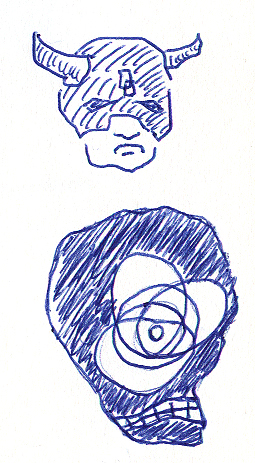
A bad sketch I once did of Daredevil and his arch nemesis Bullseye


Why such a fascination?

Daredevil always had morally complex relationships with his villains. One of his villains, a buffalo-sized man named Melvin Potter (who was also known as The Gladiator) was also shown as a gentle man who was a victim of his own mental illness. And while DD might beat him up on page four, he'd be defending him in court by page 15. One of DD's main villains, The Kingpin, was often shown in a sympathetic light... especially when the book described how brutal and chaotic organized crime would look without a strong central boss. Stoolies and low-level thugs (like the recurring character Turk Barrett) were shown as pathetic victims of their environment... people who just never really had enough smarts to think themselves off the streets. And of course, there was Bullseye, the centerpiece villain of the Daredevil series. Bullseye upped the ante. He wasn't a villain that blustered and threatened and had their plans foiled at the last minute. He actually killed people. He killed main characters. He raised the stakes of the moral conundrums. How could Daredevil see the humanity in a cold-blooded killer? Could he save the life of a scumbag like that?

In posing and answering these questions, Daredevil gave me an interesting definition of heroism. I developed a sense that heroism wasn't always about jumping into the way of danger, it wasn't just using your powers to defend the little guy from a bully. Daredevil posited a kind of heroism that challenged us to do the hardest things... to think deeper and show compassion in the face of your enemy. It suggested that heroism could also be protecting the worst of us from our own desire to punish and purge such villainy from society.

I think one of the most noble things about western civilization is the commitment to public defense. It is surely imperfect, and there are not enough genuine attempts within the penal system to actually help people get better. But to look into the faces of some of the most vile flaunters of the social contract and think, "This is still a person" is what protects us from the devolution of mob rule and the court of public opinion. I believe in it. And it's too bad that interview didn't go better, because I would have done a damn fine job... even when it made my stomach turn, because of the example Daredevil laid out for me.

Labels:

Wednesday, September 24, 2008

Comic Book Philosophy Part One

Magneto
was right


I saw these words spray painted on the sidewalk in front of my house. Obvious stencil job... the paint was magenta.

I found myself liking this graffiti tag... and thinking about it more than I normally would. Who was this tagger... Why did he or she agree with Magneto so passionately? In trying to figure out why it was on my mind, I realized what a pithy little statement this is. There's a lot of philosophy packed into those three words.

Magneto, for those who don't know, is the primary villain of the X-Men comic book franchise. A former Holocaust survivor, he learned first hand humanity's capacity to brutally persecute anyone "different." Magneto is pitted against Professor Charles Xavier, the hero. They are two opposing leaders within the same community, each with their own nuanced ideologies.

In the fictional X-Men world, there are thousands of people who experience profound genetic mutations (like sudden leaps forward in the evolutionary process.) Their mutations often give them super powers. They might also look freakish, and they may accidentally hurt people as their mutations manifest (usually in puberty.) They represent a community of people in serious danger. The rest of humanity is very suspicious and wary of these powerful young "mutants". The comic books often depict youngsters chased by angry mobs, as well as Washington politicians advocating internment camps.

While Professor Xavier starts a school, helps young mutants accept themselves and preaches peace... Magneto takes the other side. He sees another Holocaust in the making. He is the Malcolm X to Xavier's Martin Luther King. Both leaders recruit from the same pool of confused and hurt adolescents. At Xavier's school, students are lovingly taught to harness their mutant powers, and are supported through a process of developing self-esteem and groundedness. Xavier's approach is all about acceptance and patience. Magneto believes this only encourages a sheep-like acquiescence to increasing racism and hostility towards "his people". He encourages strength, rebellion and violent self-protection. His flock is not a school, but an army. He might be compared to those Jews who, after WWII, sought an Israeli homeland and were willing to become militant defenders of that homeland. The books also call to mind various civil rights era issues... occasionally comparing Magneto to those American blacks who would "go back to Africa," to those who sought to infiltrate the power system, and to those who would overthrow the power system in violent ways.

Magneto clearly represents a philosophy that power is currently held by people that do not understand those among us who are different. This lack of understanding will inevitably lead to attempts at oppression... in both spontaneous and in systemic forms. This power, and these encroachments upon the freedom and liberty of the "different" class, must be violently resisted.

In the comics, "difference" is represented by mutantkind, but the parallels to Jews, African Americans or other persecuted minorities is apparent. Given the popularity of the series, I believe that Marvel's white adolescent male readership has expanded the definition to allow self-defined freaks and geeks into the fold. Otherwise they would not identify with the product.

So I imagine this skateboard tagger kid... committing his act of civil disobedience late at night with a can of magenta spray paint... feeling so strongly bonded with the persecuted. This kid, still young... still creative... is already so hurt, or so cynical, that he's giving the finger to all the wannabe Professor X types in the world. He's saying, "No Mr. Social Worker... No Mr. Community Organizer... No Mr. English Teacher... I won't be co-opted. I won't be healed. To be accepted by you people would cost me too much. I'll maintain my minority status. I'll maintain my identity... and my people will run the underground. I'll have a home there... and if you mess with us, you'll regret it." And when I realize the power of that conviction I feel saddened at how hurtful this world can be to people.

But he's not just giving all of us peace advocates the finger; He's also pointing out how lazy and corrupt we've become... how accepting of "lesser-evilism" we've become... how much we've lost our spine. To say that "magneto was right" is to say that I'm proud of who I am and what I stand for... and I won't suffer indignities to those truths. He is our radical communist friend that chides us for supporting an insider like Obama. He is our inner vegan that knows that even organic milk promotes suffering and environmental damage. He's the neighbor that bicycles to work everyday and smiles smugly about it. He pushes us to stand up... he pushes us to accept our extreme beliefs rather than hiding them... which is an essential part of how one becomes more "heroic".

And that is why I smile everyday when I walk home past the little red letters on my sidewalk.

Labels:

Wednesday, August 06, 2008

The Importance of Games Part Four

In the wake of Gary Gygax's death last year, my friend Walaka suggested a friendly game of Dungeons and Dragons. He had missed out on the role-playing experience growing up and the death of D&D's famous founder was a good reason to finally give it a try. I still had an old box of outdated books, a set of translucent red multi-sided dice and a crapload of miniature lead figurines. And tucked away in an old peechee, I found a grand and glorious campaign I wrote in my twenties but never played. To those unfamiliar with the parlance, a "campaign" is a series of adventures that all string together and connect to a single story arc. The adventures are all set in the same land and feature the same characters. So armed, I told Walaka, "Game on!"

Approaching the game of Dungeons and Dragons as a 34 year old is a vastly different experience. In my youth, we reveled in the bloodlust of vanquishing foes. There were clear cut evildoers out there on the steppes, in the moors, moldering down in dungeons or ensconced in their mountain caves. They were all stirring up trouble and needing a good smiting. Our games revolved around combat tactics and buffing up our characters with better skills and increasingly spiffy monster-slaying gear. But my view of "evil" as a preteen boy and as a 34 year old social worker differed radically. The most central dynamic in D&D is dice-rolling combat. Armed conflict is a must, but it was much harder to justify/motivate characters to engage in slaughter as an adult.

The campaign I wrote in my twenties was much more about chaos and order than about good and evil. It was about redemption and tradition. The objectives put before the players were more about getting factions to cooperate than razing the land of evil influence. In short, we were playing a Democratic adventure, rather than a Republican one.

Since I knew the rules and had a campaign all written and ready to go... I served as the Dungeon Master. This means I had to forgo playing a character. Instead I was responsible for setting up the world around the players and posing challenges for them to overcome. One of the biggest struggles I had was painting an enemy worth killing. As children, we needed no reason to slaughter a party of orcs. They were bad guys and we were just doing our job as adventurers. But this group included several first-timers, an uncommonly balanced gender ratio, and a lot of pacifistic vegetarianism!

The most horrific scene I described was in an aside conversation with a pacifistic and spiritual kind of player. I described the war crimes being perpetrated by a desperate clan of isolated dwarves in need of spiritual redemption. I told the story of "battle not with monsters lest ye become a monster." This was the sort of theme I could identify with and enjoy exploring. In order to properly motivate her to care about the atrocities that were being committed I had to go into lengthy detail about decapitated heads mounted on pikes... guts strewn across craggy mountain passes... women and children hunted down and burned alive as examples to the enemy horde. But I found it nearly impossible to adequately depict the workaday evil of the old familiar rogues gallery. Kobolds, ettercaps, gnolls, giants, and troglodytes were all there... but mostly they became enemies by proxy as they were embroiled in conflict with the group's allies.

It was much more palatable for me to illustrate our own weakness or capacity for corruption than to point the spotlight at some evil "other". I don't know if this reflects a more nuanced (more mature) view of good and evil, or if I was just unwilling to play into "demonize and execute" strategies. Either way, I'm totally not voting for John McCain.

Labels: ,

Tuesday, June 24, 2008

Distilled as Much as Possible

Starting Premise:
There is no God. There is no higher purpose to life. We live and die in an endless stream of evolving, interconnected organisms. We eat and will some day be eaten. There is no goal or destination. If you don't buy this premise, and have a higher purpose in life, you probably can't help me here.

Conclusion:
There is no good reason to choose to continue living in this random, purposeless universe unless you are either able to enjoy life, or you have reasonable cause to think you will enjoy life again in the future. If you are bedbound due to a car accident, your life may be miserable, but you have a good chance to recover and enjoy life again. If you have advanced Alzheimers-related dementia, you are unlikely to enjoy life ever again.

Question:
What is the best way to maximize your enjoyment of life? Hedonism beckons, but we must also use our wisdom to make sure we don't overindulge. Enjoying everything to the maximum extent can cause hurtful consequences. For example, eating twenty cupcakes for breakfast is pleasurable, but being obese can deprive someone of the enjoyment of walking in the mountains.

And... how do we weigh our own level of happiness/satisfaction against that of others? Some methods of achieving maximum enjoyment in life may be hurtful to others. We obviously have responsibility there, as life would be far less simple if we didn't have a supportive society around us. Where would we get the breakfast cupcakes if we didn't have a complex set of social norms encouraging us to cooperate.

What is your path?

Labels:

Monday, June 16, 2008

Games Part Three: MoneyBall

Michael Lewis's book Moneyball has been called scintillating, controversial and "the most important sports book ever written." In fact, it's garnered so much hype over the last few years that, when given a free copy of it, I was actually willing to read it cover to cover... Illiterate though I am.

The book profiles the front office of the Oakland Athletics baseball team... the first team to openly start using modern statistical analysis and probe the question of which baseball skills most directly lead to scoring runs and winning ballgames. Lewis focuses on Billy Beane, the general manager of the team. Beane assembled a team of data crunching Harvard nerds to inform his decisions. He took decision-making responsibilities away from the manager and called most of the shots from upstairs. These pioneers threw out the old cliches and conventional wisdom. Batting average and stolen bases? Worthless... maybe even worse than worthless since those statistics tend to fool old-school talent evaluators... which leads to bad trades and bad contracts. To oversimplify: The new gospel was on-base percentage (which adds all your walks to your batting average - a much more valuable statistic.) And surprisingly, players with unspectacular batting averages often were among the league leaders in on-base percentage. There was a whole crop of underappreciated stars out there... or at least Billy Beane saw them as stars.

Secondly, they looked at how the market compensated athletes for these skills. Players adept at hitting homeruns and stealing bases were commanding disproportionate amounts of money on the free agent market. They went looking for cheap talent, because they didn't have the bucks to compete with the New York Yankees. They signed guys like Scott Hatteberg because he never swung at bad pitches and walked a lot. Wearing down the opposing pitcher (and getting a free base on balls) wasn't an expensive skill in baseball. The A's could afford to sign guys like that... so they did. And they won... a lot.

Michael Lewis spent a lot of time with the A's organization, and learned what General Manager Billy Beane and his assistants Paul DePodesta and J.P. Riccardi were up to. (DePodesta later got a shot to GM for the Dodgers and Riccardi wound up running the Toronto Blue Jays.) And Lewis does not hide his admiration for their zealous adherence to unorthodoxy.

Baseball executives have famously bragged about "not having read the book." Former Mariner's GM Pat Gillick decried it as "in poor taste". Joe Morgan, former all-star second baseman and current broadcaster repeatedly misstated that Billy Beane had written the book, and that he must be one arrogant bastard. Everyone of them felt slighted... since the book implied that the reason Beane was so successful is that everyone else in the old boys network of baseball management was incompetent at best and willfully ignorant at worst. After all, for the A's to beat the odds, they had to be screwing somebody.

However, Lewis's worship breaks down for me when I look at the bigger picture of the importance of games in my life. He sees himself documenting the triumph of reason over stupidity... as if baseball were a reenactment of the Scopes Monkey Trial. Science and reason are unassailable heroes. Lewis salivates at the prospect of Harvard grads with laptops and databases figuring out a smarter way to run a ballclub. He chortles at clubs who were repeatedly fleeced by Billy Beane's famous trades. He points out the genius of Beane's strategy at every point. But it's more like corporate ethics masquerading as science. To be ruthlessly efficient and to exploit market inefficiencies is a pathway to winning ballgames. It's the same path that Wallmart founders used to build an economic juggernaut. There is a science to it, but it isn't a paragon of "the scientific approach." And it may have unforeseen consequences.

The broader impact is that it rips away the facade of baseball. The game of baseball... a child's game played by adults and paid for by fans that want entertainment... isn't supposed to be all about maximizing your market leverage. It's about hometown heroes. It's about clutch performances. It's about which player you want to be when you grow up.

The problem is that no one ever wanted to be Scott Hatteberg.

And I dug up some actual data to make this case:

In the seven seasons from 2000-2006, the A's had a monster run... They sustained a near .600 winning percentage despite their woeful payroll. They made the playoffs five of those seven seasons. During that time span the league-average yearly attendance was around 2.3 million fans. Oakland averaged a meager 2.1 over that time frame. Their season total attendance eclipsed league average exactly once... in 2003, the year after they had won 103 games. In 2006, a year when they won 93 games and the division title, they actually drew less than 2 million fans... one of the worst showings in the league. Despite their amazing success in the win column, fans really didn't care. They didn't show up because watching guys take walks and go from base to base rather than risk an exciting stolen base attempt is boring. As much as I have tried to like this team (I always root for underdogs) I was never able to latch on to any of their players either.

Compare this to 1988-92, when Tony LaRussa's club made it to the post-season four out of five years. Jose Canseco and Mark McGwire powered a high-octane offense. Rickey Henderson stole every base in sight. These were a rip-snorting, steroids-injecting bunch of bashers. The average attendance per year for that half-decade was significantly above league-average (about 2.6 million fans per season compared to a league-average of 2.2 million.) People just 12 years earlier had shown up in droves for this same team.

Billy Beane decided somewhere along the line that winning ballgames was the most important goal... Win and everybody's happy. The Mariner's front office conversely seems to have decided that making money is the bottom line, so they worry more about drawing 3+ million fans every year than they do about winning. They put more thought into their funny advertising campaign each year than they do the annual draft.

Personally, I find that the real bottom line... the line that everyone keeps smudging... is entertainment. Professional baseball shouldn't exist. It's ridiculous that we pay grown men tens of millions of dollars a year to play a kid's game. It's ridiculous that I follow it as closely as I do. The only reason I pay any attention to this game is for its entertainment value.

Beane and company are changing the way the game is played behind the scenes (constantly evaluating the market to see what skills are undervalued.) They're also changing the way the game is played on the field (fewer stolen base attempts, more emphasis on taking pitches.) These changes have resulted in more wins. More wins means that other teams are adapting to this approach. Already on-base percentage has become overvalued and the A's have had to start searching for other interesting stats. It's an ever evolving process of trying to outshark the next guy.

The problem is that walks are a loophole. They are a penalty invented by the framers of the game. They aren't what baseball is supposed to be about. The core of the game, which is what made the game popular in the first place, is a pitcher trying to throw the ball past a guy doing his best to knock the stuffing out of it. Walks are boring. They slow down an already glacial game even more. And yet, Beane's success is changing the landscape of baseball so that more and more players are trained to look for walks. This is, as reflected in the attendance data cited above, BAD FOR BASEBALL... because baseball is still about entertainment and walks can never replace the core dynamic of the game.

Hopefully this has just been a market-correction blip, rather than a permanent change. Otherwise baseball is in trouble. Someone upset the applecart and now Bud Selig and the rest of the game's leadership is going to be hardpressed to fix it. Michael Lewis sees this as something to celebrate... a new kind of enlightenment. I don't think I can agree.

Labels: ,

Monday, June 02, 2008

The Importance of Games Part One

Late at the bar, after a bruising night of basketball, the question arises: "Who's the greatest athlete of all time?" The answers fly... Jim Thorpe, Jim Brown, Bo Jackson, Barry Sanders (my pick), Michael Jordan, Muhammad Ali, Jesse Owens, Pele, Gretsky... the argument goes on. No one mentions Sergei Bubka (who was absolutely dominating in his field) because pole vaulting is too much of a specialized skill. No one says Kasparov because concentration and competitiveness are not enough to make someone a world-class "athlete". Someone says Tiger Woods and I groan loudly. I counter with Lance Armstrong and the rest of the table groans.

I ponder the etymology of the question. What are we really asking here? Why do we put so much stock into someone's ability to excel at sports? What are we actually measuring when we ask who is the "best"? Wilt Chamberlain scored 100 points in a game, but Bill Russell won eleven championships. Which feat is more impressive?

And one level deeper: why do we play these games? What purpose do they serve? Why do we admire these athletes to the point of paying them tens of millions of dollars per year? All I can come up with is that games (and specifically sports) are so important to us because they play two indispensable roles in society: we use them as indoctrination for our youth, and we use them in our adulthood as a way to sublimate our human blood lust into socially acceptable outlets.

The second path (sublimation) is most prevalent among middle-aged men who follow sports religiously. We have fantasy teams, watch ESPN highlights nightly and attend several games a year in person. We are looking for gladiators here. We follow athletes that act as our avatar on the battlefield. We honor athletic endeavors that are thinly veiled approximations of warfare. Football is perhaps the most warlike... with its sideline generals, teams comprised of field leaders, grunts and "skill guys" who use speed and deception to outflank the front lines and wreck havoc in enemy territory. Many sports like basketball, soccer and hockey follow a similar "penetrate the defense and attack the goal" model. Boxing, wrestling and martial arts are a stripped down version of the man-to-man "erete in combat" that the Greeks used to wax on about. The qualities we measure in our sports heroes are guile, speed, strength, endurance, coordination, mental discipline, and leadership... exactly what the US Army is looking for in their special units recruits.

As for the other path... the training (conditioning?) of our nation's youth... I reflect on my own childhood and see these same qualities being glorified as far back as 3rd grade. That was the year that I finally caught five balls during our morning "Flies Up" game... when one boy would huck a football as far and high as he could and all the other kids would crowd beneath, shoving and kicking and biting, and attempt to catch the ball. Whoever was tough, fast or lucky enough to catch five had the privilege of being the next to throw it. When I finally got my chance, the crowd gathered at a medium distance (unsure of what to expect of me.) I wound up and threw it ten yards beyond the furthest kid back, drawing a few oohs and ahhs from the crowd. The next day, during the longer lunchtime recess when we all played football, I was invited to play quarterback for the first time. This was an extreme honor, and something that young boys took very seriously. And even though I could throw the ball a long way, I didn't have the leadership and play-calling chops to survive long at the position before being ousted. Still, one week of getting to play QB was the highlight of the year for this 8 year old.

I don't know why it mattered so much... or what flaw in my character allowed me to accept being demoted without a fight. Perhaps I am missing the gene that allows Hillary to keep slugging even with her chances fading and the pressure to quit mounting. Maybe this is the Rocky Balboa gene? But I kept playing football, and developed a kind of respect for the early manifestations of athleticism we prepubescent boys displayed. I respected Jason Lindblad's speed, Eugene Madayag's size and power, and Mike Forbes' trickery in baiting opposing quarterbacks into throwing him the ball even though he was on the opposing team. And it even started making sense to me when some games would deteriorate into fist fights (this started happening in the fourth grade.) I wasn't involved in any of these fights... but it is curious that it didn't even seem "wrong" to me. After all, I was a very pacifistic child... I didn't even kill ants or torture grasshoppers the way other boys did. Along side the rest of my elementary schoolmates, I was being trained to respect athletic success beyond academic or artistic excellence... and way beyond simple traits like honesty, humility, common sense or decency.

As I endured high school, it was sickeningly apparent that popularity was entirely controlled by the jocks... those who had demonstrated and cultivated athletic aptitudes since the third grade. Luckily, as a nerd, it was easy to opt out. Popularity really didn't matter to us. We accepted that sports, dances, student government and pep-rallies weren't made for us... And they accepted that biology, foreign languages, mathematics, physics, history, acting, painting, and literature weren't made for them. It amazes me to this day how much importance my school (and our society) placed on these athletes... It's almost as difficult as understanding why I continue to play so many of these sports, and why it feels so good (as a 34 year old social worker fergawdsake) to have hit a game-tying home run in the final inning of my softball game last night.

Labels:

Monday, May 12, 2008

Last Week's Spirit Animal: The Billygoat

My scruff was getting long... Three weeks without shaving. And the spring air had me operating at "ramming speed." After coming out of the Cinerama (where I had just taken in the action-packed Iron Man) I spontaneously headbutted my friend Dan in the chest. Luckily Dan expects this kind of behavior and takes it as well as he dishes.

The next night, in a heated basketball contest, my friend JohnB and I slammed foreheads as we both lunged after a loose ball. After the initial dizziness wore off (the circling stars and bluebirds all went back to their roosts) I felt strangely... energized. Instead of wanting to sit out for a few minutes, I felt like I wanted to get back into action immediately.

And the next day at work, I found myself playfully headbutting my coworker.

What's going on? I hadn't headbutting anyone (accidentally or intentionally) in years. Now I feel like I'm on a rampage. Is this just a springtime rutting season instinct making its primal force known?

Whatever, the cause, I realize I need to be careful. I've been feeling like taking on all comers lately. Some stresses at work have made me feel like headbutting managers, board members and consultants alike. A CEO from the Eastcoast that represents a newly trademarked Full Belly Project, who wants us to "cease and desist" from using the name, is practically begging for an "Irish Kiss" straight to his noggin. Somewhere the Buddha is sending me compassion... but my first reaction is to ram him right in the belly!

Labels: ,